
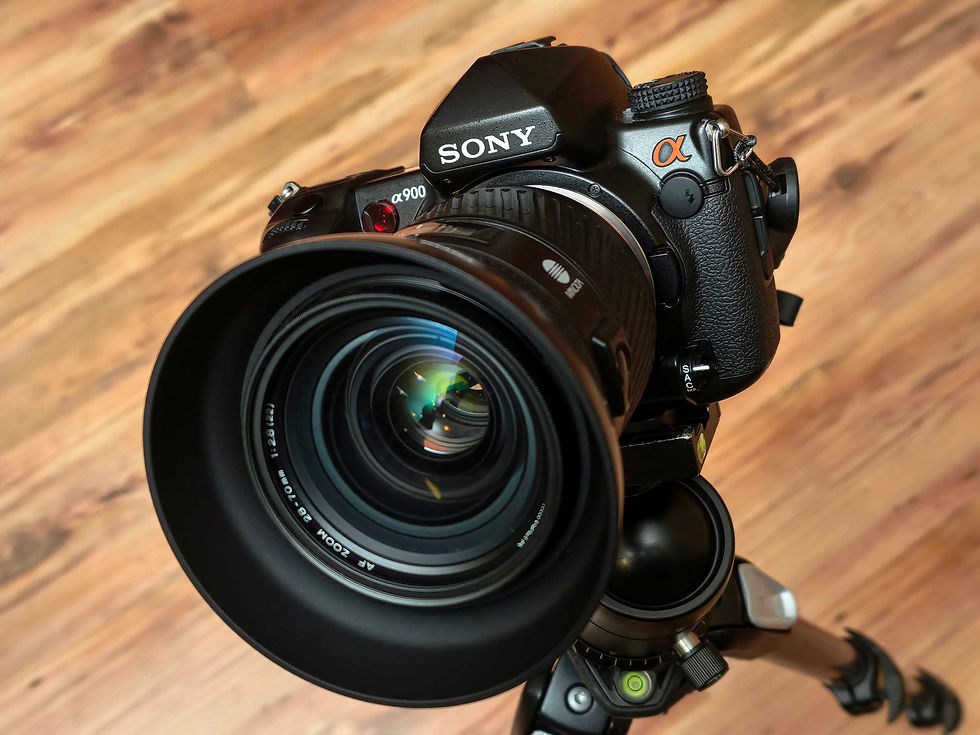
Die Sony A900 – eine kleine Liebeserklärung
Click here for the text in English.
Es gibt Kameras, die einfach nur Werkzeuge sind.
Und es gibt Kameras wie die Sony A900.
Letztere nimmt man in die Hand und spürt sofort: Hier hat sich jemand wirklich etwas gedacht.
Als sie 2008 vorgestellt wurde, war sie Sonys Ansage an die Fotowelt: Vollformat, 24,6 Megapixel, ein riesiger, heller optischer Sucher und ein Gehäuse, das eher an klassische Profi-SLRs erinnert als an die damals aufkommenden Plastikbomber. Heute, viele Jahre später, ist sie technisch natürlich überholt – und trotzdem hat sie etwas, das viele moderne Kameras nie erreichen: Charakter.
Schon das Design erzählt eine Geschichte. Die A900 trägt das Erbe von Minolta in sich, vom Bajonett über die Bedienlogik bis hin zur Art, wie sie in der Hand liegt. Keine unnötigen Schnörkel, sondern klare Linien, ein massives Gehäuse, direkt erreichbare Knöpfe und Räder. Wer mit der Kamera arbeitet, hat das Gefühl, mit einem präzisen Werkzeug zu fotografieren, nicht mit einem elektronischen Gadget.
Das Herzstück ist der Sucher. 100 % Bildfeldabdeckung, riesig, hell, mit einer Klarheit, die man erst so richtig zu schätzen weiß, wenn man wieder in einen kleineren Sucher schaut. Durch diesen Sucher zu blicken, ist fast schon ein eigener Grund, die A900 mitzunehmen. Man komponiert bewusster, langsamer, aufmerksamer. Jede Linie im Bild, jede Horizontkante, jeder Vordergrund bekommt mehr Gewicht, weil man sie so groß und deutlich vor sich sieht.
Der Sensor der A900 mag aus heutiger Sicht „nur“ 24 Megapixel liefern, aber er tut es mit einer Anmutung, die gerade bei guten Objektiven begeistert. Die Dateien sind klar, knackig und lassen sich hervorragend bearbeiten. Vor allem im niedrigen ISO-Bereich liefern die RAWs eine Zeichnung und Farbigkeit, die erstaunlich zeitlos ist: nichts wirkt übertrieben glattgebügelt, nichts schreit nach künstlicher Schärfung.
Dazu kommt ein Feature, das Sony schon lange vor vielen anderen zur Perfektion gebracht hat: der integrierte Bildstabilisator im Gehäuse. Plötzlich werden auch manuelle Festbrennweiten und ältere Minolta-Gläser „stabilisiert“, ohne dass das Objektiv dafür eine eigene Technik bräuchte. In Kombination mit den legendären Carl Zeiss Objektiven für das A-Mount entsteht eine Bildqualität, die auch Jahre später noch absolut überzeugend ist.
Die Bedienung ist herrlich analog im besten Sinne. Keine überfrachteten Menüs, keine Touchscreens, die Fingerabdrücke sammeln, sondern solide Tasten, ein klares Statusdisplay und direkte Kontrolle über das, was beim Fotografieren wirklich zählt: Zeit, Blende, ISO, Fokus, Belichtungskorrektur. Man fotografiert wieder mit dem Auge am Sucher, statt im Menü zu scrollen.
Natürlich kann die A900 keine 20 Bilder pro Sekunde, kein lautloses Auslösen, kein 8K-Video. Aber wer mit ihr unterwegs ist, sucht meistens etwas anderes: Entschleunigung. Bewusstes Sehen. Das Gefühl, eine Kamera zu benutzen, die für Fotografie gebaut wurde – nicht für Content-Produktion im weitesten Sinne.
Die Sony A900 ist ein bisschen wie ein schöner, gut erhaltener Oldtimer: Es gibt schnellere Autos, sparsamere Autos, Autos mit mehr Assistenzsystemen. Aber wenn man im A900-„Cockpit“ sitzt, den Spiegel klacken hört und durch diesen riesigen Sucher schaut, ist all das egal. Dann geht es nur noch um das Bild.
Vielleicht ist genau das ihre größte Stärke: Sie erinnert einen daran, warum man überhaupt angefangen hat zu fotografieren. Wegen des Blicks durch den Sucher. Wegen des Moments, in dem alles im Bild zusammenpasst. Wegen der Freude an einem Werkzeug, das nicht perfekt sein muss, um geliebt zu werden.
Die Sony A900 ist keine aktuelle Kamera mehr. Aber sie ist eine, die bleibt. In der Hand, im Regal und vor allem im Herzen derjenigen, die einmal ernsthaft mit ihr fotografiert haben.
The Sony A900 – a Little Love Letter
There are cameras that are just tools.
And then there are cameras like the Sony A900.
The moment you pick it up, you can feel it: someone really thought this one through.
When it was introduced in 2008, it was Sony’s statement to the photo world: full-frame, 24.6 megapixels, a huge bright optical viewfinder, and a body that felt more like a classic pro SLR than the plastic gadgets that were starting to flood the market. Today, many years later, it’s of course outdated on paper – yet it still has something a lot of modern cameras never quite achieve: character.
The design alone tells a story. The A900 carries Minolta’s DNA, from the mount to the control layout to the way it sits in your hand. No unnecessary frills, just clean lines, a solid body, and well-placed dials and buttons. When you work with this camera, it feels like using a precise instrument, not an electronic toy.
At the heart of it all is the viewfinder. 100% coverage, huge, bright, and so clear that you only really appreciate it after going back to a smaller finder. Looking through it is almost reason enough to take the A900 along. You compose more deliberately, more slowly, more attentively. Every line in the frame, every horizon, every foreground element gains weight because you see it so large and so clearly.
By today’s standards the A900’s sensor delivers “only” 24 megapixels, but the way it renders an image – especially with good glass – is still impressive. The files are clean, crisp, and very workable. At low ISO in particular, the RAWs have a tonality and color that feel surprisingly timeless: nothing looks over-smoothed, nothing screams for artificial sharpening.
On top of that, there’s a feature Sony nailed long before many others: in-body image stabilization. Suddenly, even manual primes and older Minolta lenses are “stabilized” without needing any special tech in the lens itself. Paired with the legendary Carl Zeiss lenses for the A-mount, the A900 can still produce image quality that holds its own years later.
The handling is wonderfully analog in the best possible sense. No bloated menus, no fingerprint-smeared touchscreens – just solid buttons, a clear top display, and direct control over what really matters when you’re shooting: shutter speed, aperture, ISO, focus, exposure compensation. You’re back to shooting with your eye in the viewfinder instead of scrolling through menus.
Of course, the A900 doesn’t do 20 frames per second, silent shutter, or 8K video. But most people who take it out aren’t looking for that anyway. They’re looking to slow down. To really see. To enjoy the feeling of using a camera that was built for photography, not for “content creation” in the broadest sense.
The Sony A900 is a bit like a beautifully preserved classic car. There are faster cars, more efficient cars, cars with more driver aids. But when you’re in the A900 “cockpit,” hear the mirror slap, and look through that huge viewfinder, none of that matters. In that moment, it’s all about the photograph.
Maybe that’s its greatest strength: it reminds you why you started taking pictures in the first place. Because of the view through the finder. Because of that split second when everything in the frame lines up. Because of the joy of using a tool that doesn’t have to be perfect to be loved.
The Sony A900 is no longer a current camera. But it’s one that stays with you, in your hand, on the shelf, and especially in the hearts of those who have truly spent time shooting with it.